I was only ten years-old but had revealed some aptitudes for running at school. My uncle had offered me a book soberly entitled Marathons, in which I discovered two world records that were then considered as supernatural and almost unbeatable: the one, for men, by the Portuguese Carlos Lopez (2 h 07 min 12 s, established in 1985), and the other, for women, by the Norwegian Ingrid Kristiansen (2 h 21 min 06 s, also established in 1985). When I started training on trails and roads and discovered that I could be relatively ‘good’ on long-distance races, at the beginning of the 1990’s, my heroes were the three first men of the 1992 Paris Marathon: Luis Soares (2 h 10 min 03 s), Pascal Zilliox (2 h 11 min 11 s), and Jean-Baptiste Protais (2 h 12 min 23 s). In these times, breaking the bareer of the two hours for the 42.195 km was considered as a total utopia and physiologically unfeasible. Nowadays, it is the logical and further step for part of the elite’s runners.
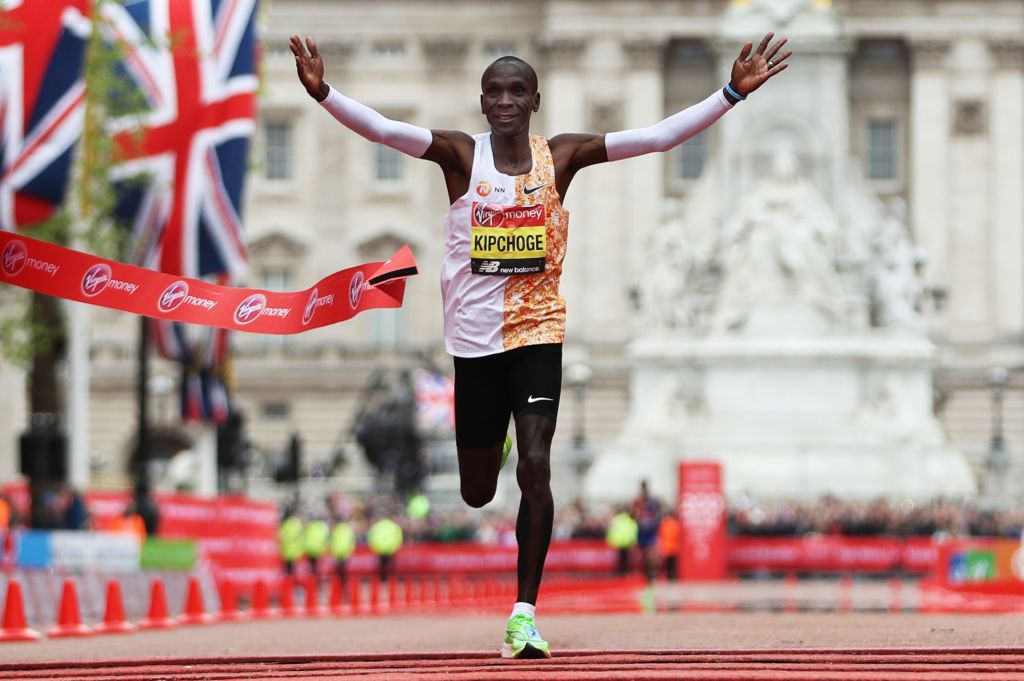
Indeed, at the turn of the millenium, everything burst with the arrivals of many younger and frequently Eastern Africa-originating athletes and the progresses in training techniques. In exactly fourty years, the men’s and women’s international records on the mythical distance were lowered by more than 6 min and 11 min, respectively — which is huge, considering the difficulty of this sport. Also, the frequency of the marathon world record’s breaking increased, especially in the men’s category. Since 2003, the men’s marathon world record has been beaten nine times by, successively: the Kenyan Paul Tergat (2 h 04 min 55 s, in 2003), the Ethiopian Haile Gebrselassie (2 h 04 min 26 s, in 2007, and 2 h 03 min 59 s, in 2008), and the Kenyan Patrick Makau (2 h 03 min 38 s, in 2011), Wilson Kipsang (2 h 03 min 28 s, in 2013), Dennis Kimetto (2 h 02 min 57 s, in 2014), Eliud Kipchoge (2 h 01 min 39 s, in 2018, and 2 h 01 min 09 s, in 2022), and Kelvin Kiptum (2 h 00 min 35 s, i.e., 21 km/h on average, in 2023). And, since 2003, the women’s marathon world record has been beaten four times by, successively: the British Paula Radcliffe (2 h 15 min 25 s, in 2003), the Kenyan Brigid Kosgei (2 h 14 min 04 s, in 2019), the Ethiopian Tigist Assefa (2 h 11 min 53 s, in 2023), and the Kenyan Ruth Chepngetich (2 h 09 min 57 s, i.e., 19.5 km/h on average, in 2024). From another side, in Fall 2019, the abovementioned Kenyan Eliud Kipchoge achieved a time of 1 h 59 min 40 s at the Ineos 1:59 Challenge in Vienna, becoming the first athlete in recorded history to run the marathon distance in less than two hours; neverheless, the run did not count as a new world record, since standard competition rules for pacing and fluids were not followed and it was not an open event. Also, the Dutch Sifan Hassan, who was introduced in the first article of this blog and was initially a brilliant middle-distance specialist, won the 2023 Chicago Marathon in 2 h 13 min 44 s. The list of impressive performances is endless. Let’s just furthermore precise that the men’s and women’s marathon France records are held by Morhad Amdouni (2 h 03 min 46 s, in 2024) and Mekdes Woldu (2 h 23 min 13 s, in 2025), respectively — which reveals to a certain extent how the ‘explosion’ of the performances on marathon is totally ‘global’.
For the majority of the ones having taken part to marathon races and/or having examined the discipline in the past, such times reveal literally ‘insane’; are all those runners real men and women? What do they actually feel approaching the finish line? Where is the human limit on such a distance? Some may raise some questions related to the performances’ ethics? We’re neither analysts nor scientists — and what can we say when we get on the field and on-screen what we want and beg for: light and magic?…
Soundtrack: « Golden Gun », by Suede (2002).
 Music Meets Running
Laisser un commentaire